Last updated August 2026
The bit that stops most people is the front door
Almost nobody’s hesitation about martial arts is really about martial arts. It is about walking into a room full of people who already know each other, who already know what they are doing, and looking like an idiot in front of them.
★View the Best Martial Arts Schools in Wellington→That fear is completely standard and it is also, in most Wellington clubs, unfounded, but “you’ll be fine” is not much use as reassurance. What actually helps is knowing in advance what the first month contains. So here it is, roughly in order.
Week one: less than you are imagining
You will not be thrown in with experienced people and you will not be sparring. Most clubs run a separate beginners class precisely so this does not happen.
A first session is usually a warm-up, then one or two techniques broken down and drilled slowly with a partner who is also a beginner or is deliberately there to help you. Drilling means repeating the movement cooperatively: nobody is resisting, nobody is trying to win. You will get things wrong constantly, which is the point of drilling.
What surprises most people is how much of it is thinking rather than fighting. The first few weeks are largely about learning where your own limbs are supposed to go.
What to wear and bring
For the first few classes: comfortable clothes with no zips, buttons, studs or anything that can scratch or catch, so a plain t-shirt and shorts or trackpants. A water bottle. That is it.
Do not buy a uniform before you start. If you stay, you will buy a gi or rash guard depending on the style, and the club will tell you what you need. Second-hand uniforms turn up regularly on Trade Me and Facebook Marketplace, which is worth knowing if you are kitting out a child who will outgrow it long before they wear it out.
A mouthguard is worth getting once you start doing anything resistant.
The etiquette nobody explains beforehand
Every gym has unwritten rules, and not knowing them is a large part of the intimidation. The common ones:
- Cut your fingernails and toenails. This is the most-broken rule and the one most likely to earn you a quiet word. Long nails scratch training partners.
- Turn up clean, in clean kit. You will be in close contact with people. Wash the uniform after every session, not every third.
- Tap early and often. In grappling styles, tapping is how you signal to stop. It is not losing and it is not weakness. It is the safety mechanism the entire training method relies on. New people who refuse to tap get hurt.
- Don’t train sick, and cover skin infections. Mats are shared.
- Bow, or don’t, but watch what the room does. Customs differ by style and club. Copying the person next to you is a perfectly good strategy.
- Tell your partner about injuries before you start, not after.
None of this is precious. It is all just what happens when people train in physical contact several times a week.
How sore you will be, and the injury question
Sore in places you did not know existed, for the first fortnight. Grip, neck, hips, obliques. It settles.
On injuries: contact sport carries risk and nobody honest will tell you otherwise. What varies enormously is how much risk, and it depends on the style. Grappling arts, where the aim is control and submission rather than striking, let you train at close to full effort against a resisting partner with relatively low risk, because there are no head strikes involved. Striking arts manage the same problem by controlling contact levels in training.
If you have a specific concern (a bad shoulder, a history of concussion, a dodgy knee) say so on day one. A good instructor will work around it. An instructor who waves it off is telling you something.
What it costs in Wellington
Expect a weekly or monthly membership rather than pay-per-class, though most clubs offer casual rates. Beginner-only memberships are usually cheaper than unlimited access, because you are training fewer sessions.
Most clubs run a free or discounted trial (a class or two free, or a couple of weeks at a reduced rate) and there is no reason to sign anything before you have used it. Student discounts are common in Wellington for obvious reasons.
Budget separately for a uniform if you stay past the first month.
Kids’ classes are a different thing entirely
Children’s martial arts is less about self-defence than parents expect and more about attention, self-regulation and physical confidence. The good programmes are heavy on structure and games and light on lecturing.
Most clubs let a child try free before committing, and term-based fees are normal. Watch a class before enrolling. How the instructor talks to the kids at the back who are not paying attention will tell you everything.
Give it two months before you decide
One class tells you almost nothing except whether you liked the room. The learning curve is steep enough that four weeks in you are still mostly confused, and around the two-month mark is usually when things start connecting and it becomes obvious whether it is for you.
The other thing that takes about that long is the social side, which is the actual reason most people stay.
Where GSW fits
GSW is a Brazilian Jiu Jitsu club in central Wellington, in Te Aro. It has been running since the 1990s. Geoff and a small group first trained BJJ under John Will in 1995 and aligned the club with him in 1998.
Beginners classes run Tuesday and Thursday at 6pm, and new people stay in that class for around eight to ten sessions before the wider timetable opens up: no live rolling in that period, just technique and drilling. Their beginners page sets out how to join and what the introductory rate covers.
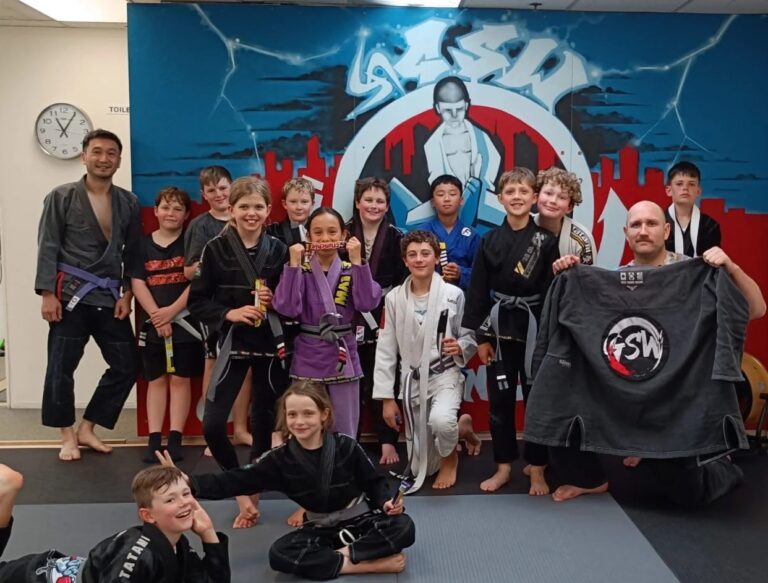
Kids’ classes run Sunday mornings for ages seven and up, split by age, with the first two classes free.
If you have questions before turning up, email gs*****@***il.com.